www.6dofsim.org
six degrees of freedom simulator

[ home ]      [ input ]        concept        [ system design ]      [ mech design ]      [ hw design ]      [ sw design ]      [ integration ]      [ improvements ]      [ tools ]      [ links ]      [ contact ]


Sim dynamics
acceleration
Taking the max t/o thrust of 143kN at a mass of an empty A320 + 5t of fuel will give an acceleration of
  F = m * a --> a = F/m = 286kN / 47t = 6.08m/s^2;
As a fraction of gravity this gives:
  6.08 / 9.81 = 0,61977;
Resulting in a "nose up" reaction of the sim of:
  arctan(0,61977)=9,9712deg=32deg;
The pilot "looses" 15% of his weight (cos32deg=0.85). This is somewhat beyond a 10% accuracy envelope, but shall be ok beeing not the pilots target focus in a max breaking condition.

pitch 'nose up'
"nose up pitch" during flight is considered max 30deg.

braking
Taking 1440m / 137kt, this results in (linear deceleration):
  a = - v^2/2x = -(70.479m/s)^2/2*1440m = -1.7248 m/s^2;
As a fraction of gravity this gives:
  -1.7248 / -9.81 = 0.17581;
Resulting in a "nose down" reaction of the sim of:
  arctan(0.17581)=9,9712deg=10deg;
Pilot weight is still 98% (cos10deg=0.98), so well within the above named 10% accuracy envelope.

pitch 'nose down'
"nose down pitch" during flight is considered max 30deg.

bank
Bank angle is known on Airbus A320 max 60deg when forced by the pilot, reduced to 30deg when the sidestick is released.


Sim dimensions
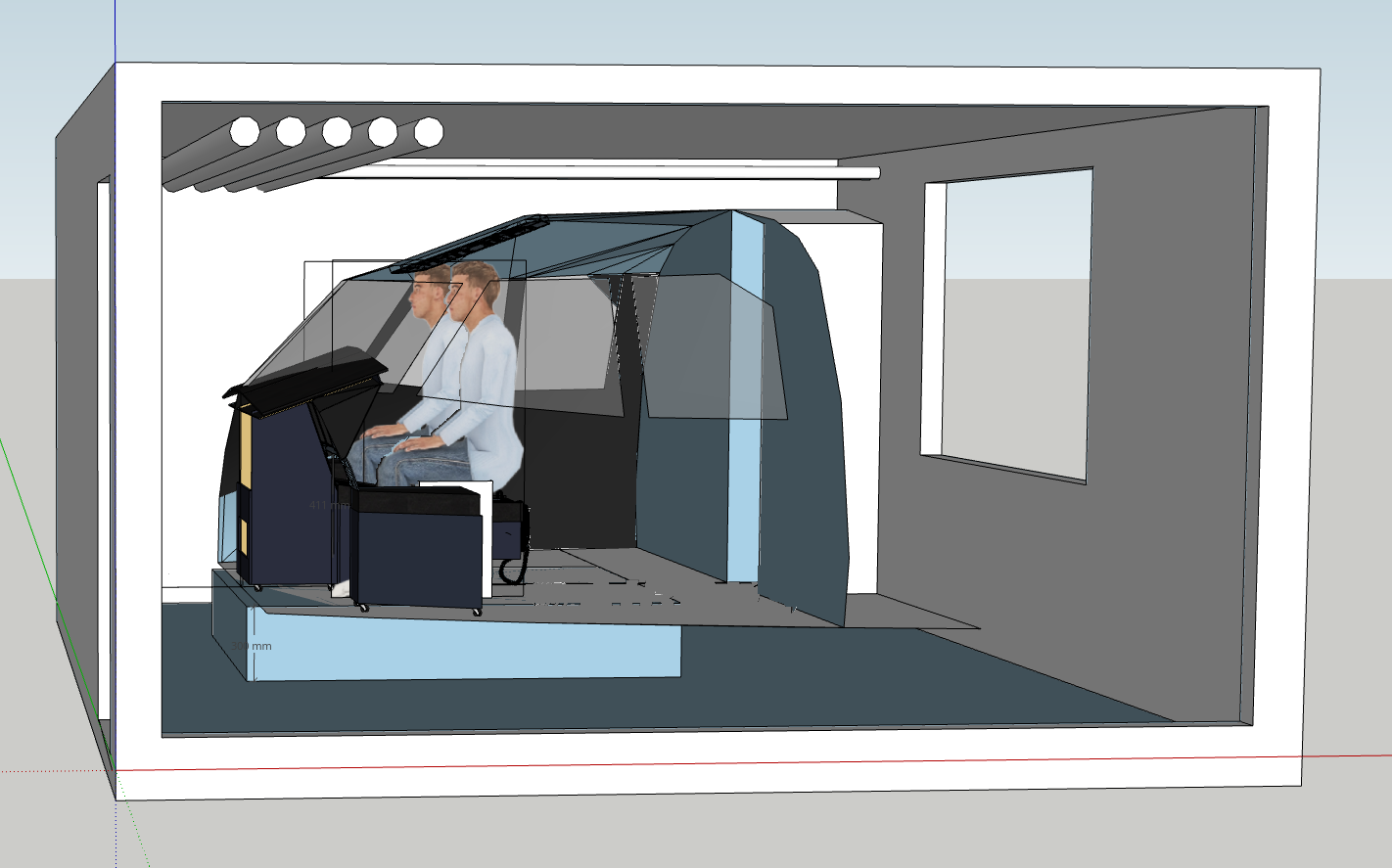
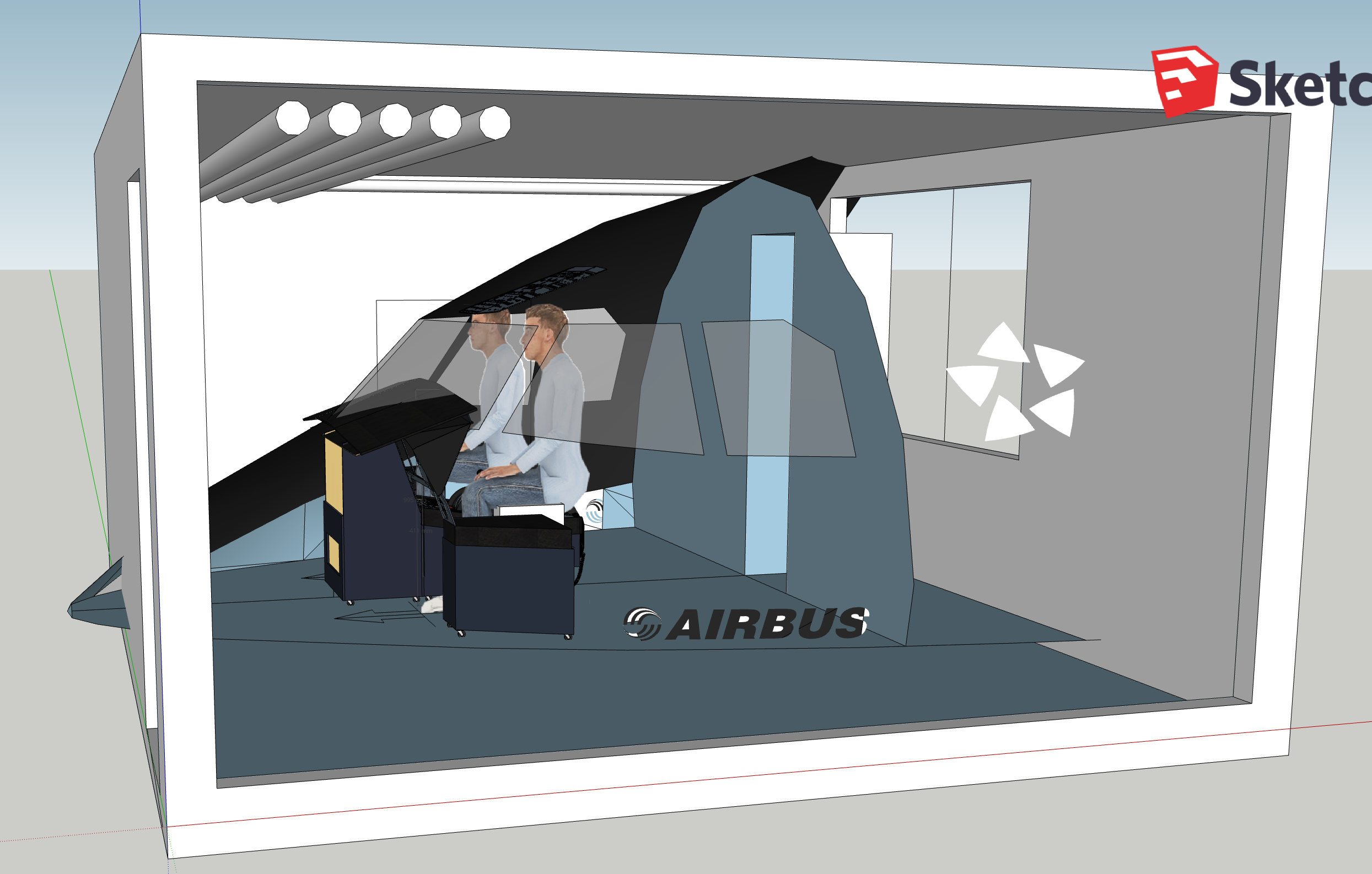
1st try of a full size cockpit. As expected it is too big, but hopefully within a range to get it matched:

Raum
(A320 shell, interieur and figure from SketchUP "3D Warehouse")

The cockpit shell needs to get reduced, in fact the question is "how much" as it shall be kept as roomy as possible.
Cockpit height is given finally by the room height:
Room height220 cm
Safety space2x  5cm10 cm
6dof travel2x 25cm50 cm
Cockpit structure2x  5cm10 cm
Resulting max inner cockpit height150 cm


This 1st attempt leads to a overhead panel mounting which is not as it is on an A320: The upper end is at a level of 1544mm above cockpit ground. At least the lower overhead panel should be "as real as it is", the upper one with all the circuit breakers may anyway not be operated, for display only, will not be realized, when not positioned correct..

Originally the structure was intended to be built up of 5cm aluminum profiles ("Bosch Profile"), but the strength may also be reached by a increased number of 3cm profiles (actually proposed to...) with additional supporting struts in the main panel area as well as in the aft cockpit section in the circuit breaker panels.

The safety margin above and below the cockpit may be decreased to 2cm each, requiring additional means to prevent harms (eg squeezed hands / arms).

By this, inner cockpit height gets increased to 1.60m and all panels in an "as real" setup:
Room height220cm
Safety space2x  2cm4cm
6dof travel2x 25cm50cm
Cockpit structure2x  3cm6cm
Resulting max inner cockpit height160cm


Raum

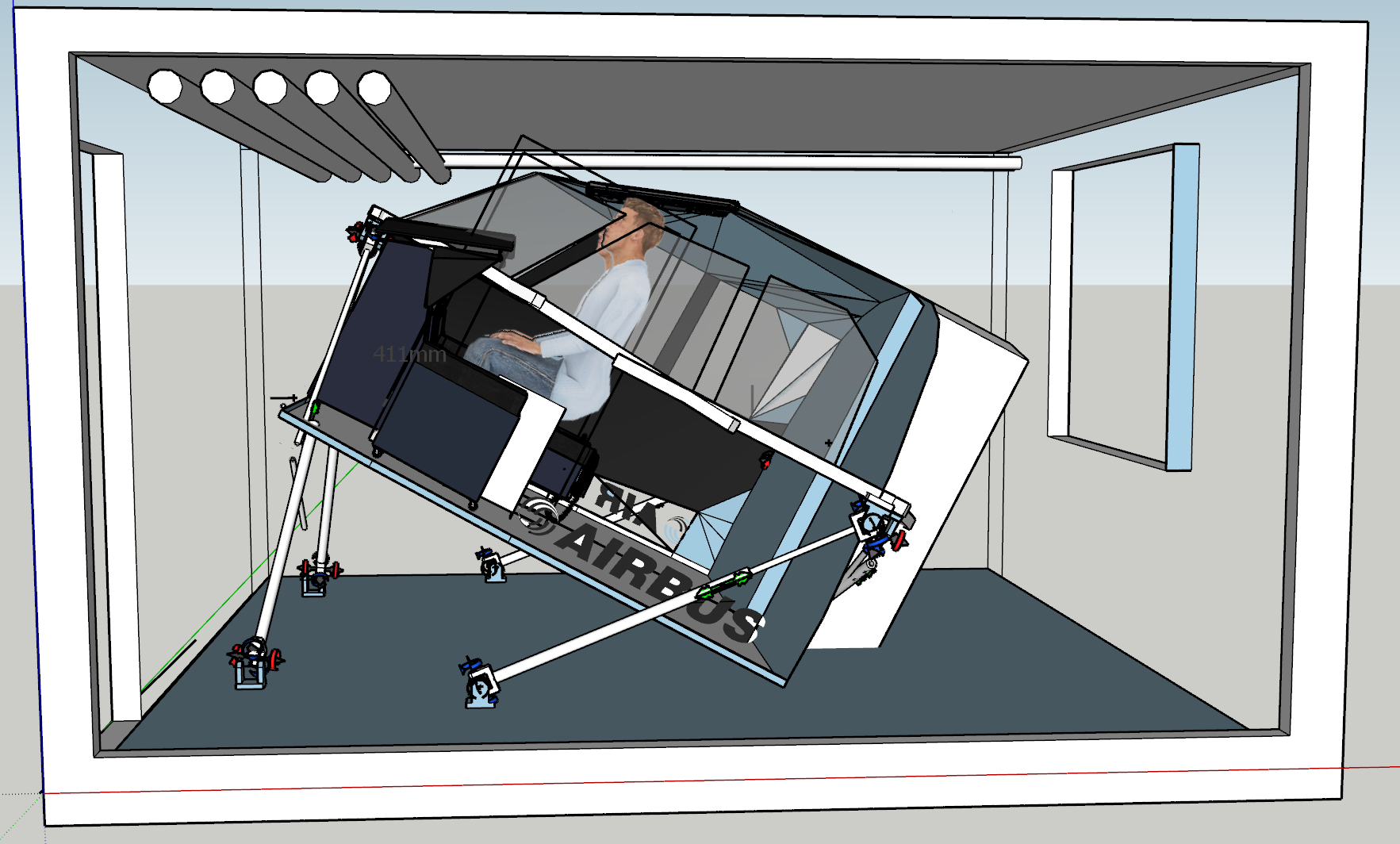
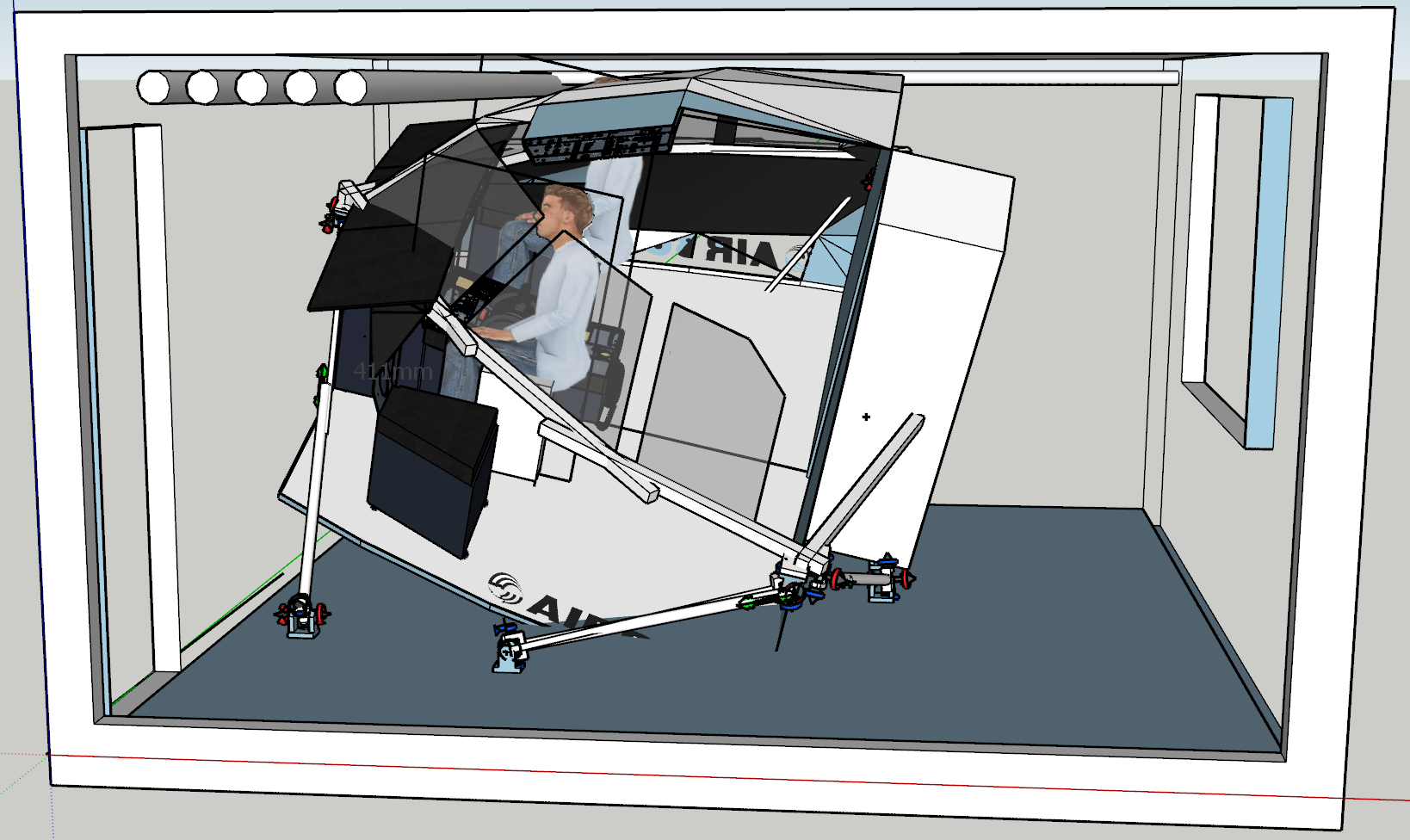
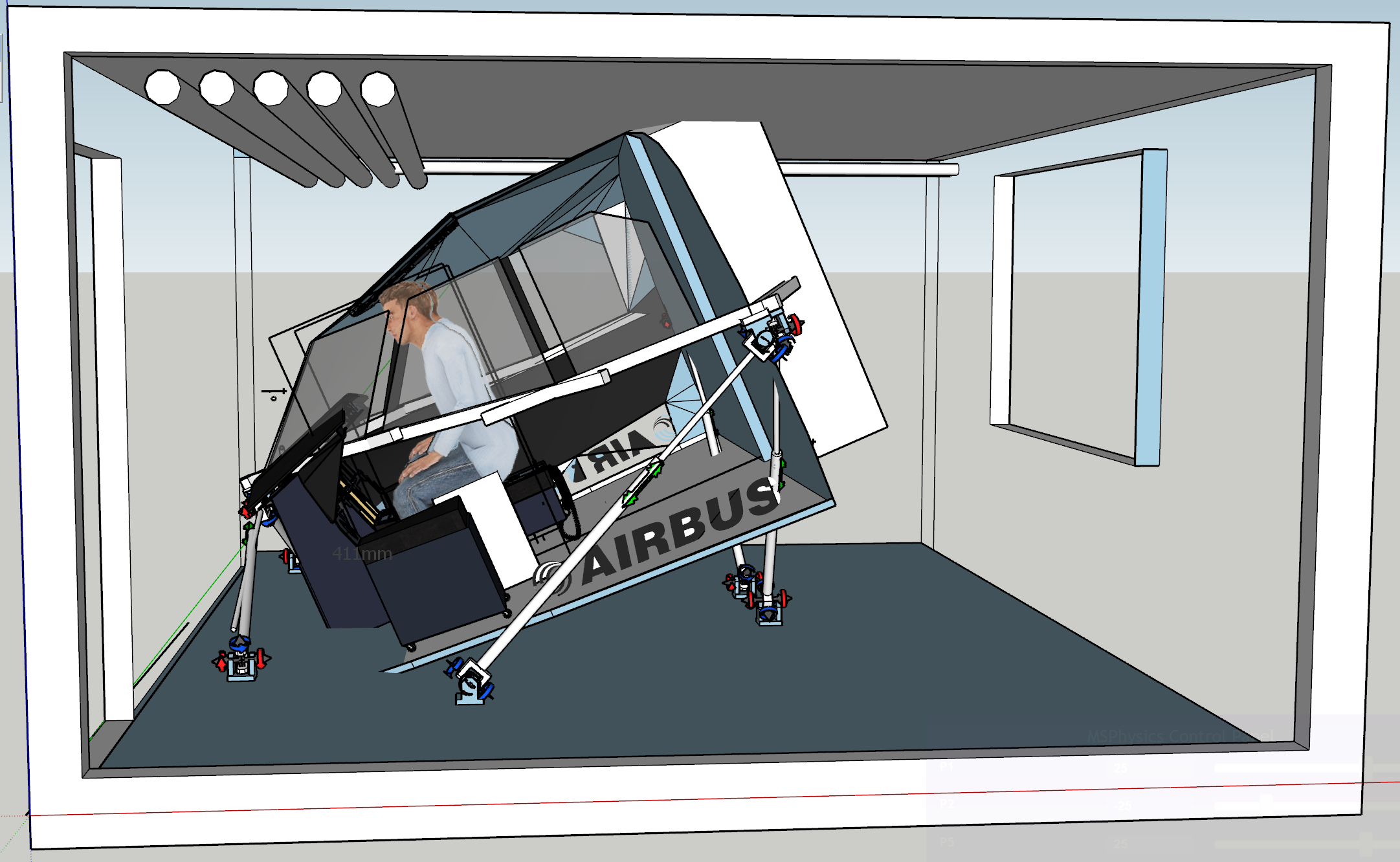
To get an idea of sim-angles and sim-movement, I did a SketchUp / MSPhysics model of a possible A320-cockpit-hexapod-combination. I was aware, that our hobby-room would get an impressive new resident, but that there would not be space for anything other, I had not in mind.
To get the limits of movement, I assumed there would be 3 flight conditions, forcing the sim to operate at its limits. Beside setting max T/O thrust and climb pitch, this would be max braking at dry rwy and crosswind during an ILS approach. Having Innsbruck in mind (LOWI), this could be a quite effordable bank during local storm conditions (Föhn-Sturm).

Max T/O thrust & climb:
Max T/O thrust & climb

Max bank during ILS approach:
Max bank during ILS approach

Max brake condition:
Max brake condition


As a result of this very first 'try', it needs to be realized, that IF ANY the sim can only operate in realistig behaviour, by following tradeoffs to the cockpit:
- The front section at the feet of the pilots needs to be shortened as max as possible.
- The cockpit door may get redesigned, beeing more "compact".
- The aft section of the cockpit gets a cut on the floor below the aft cockpit window.


Vision
basics regarding optics / physics
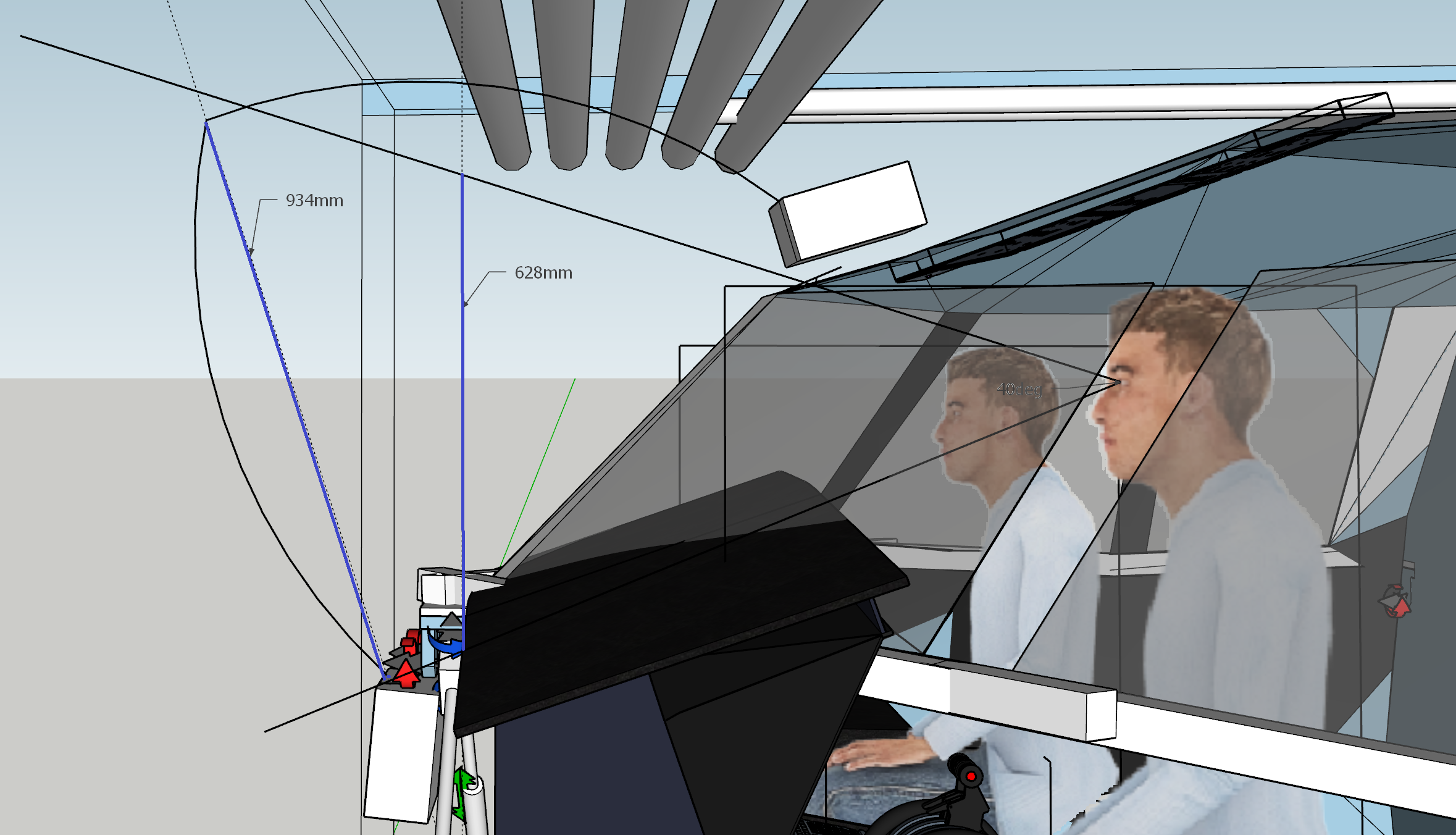
Pilots angle of view as PF is about 40deg, facing a picture of 934mm (projector) or 628mm (monitor) of height. Matching the resolution of an eye, 2400 pixel per 934mm (projector) or 628mm (monitor) are necessary.
Angle of PF sight, projected picture heights

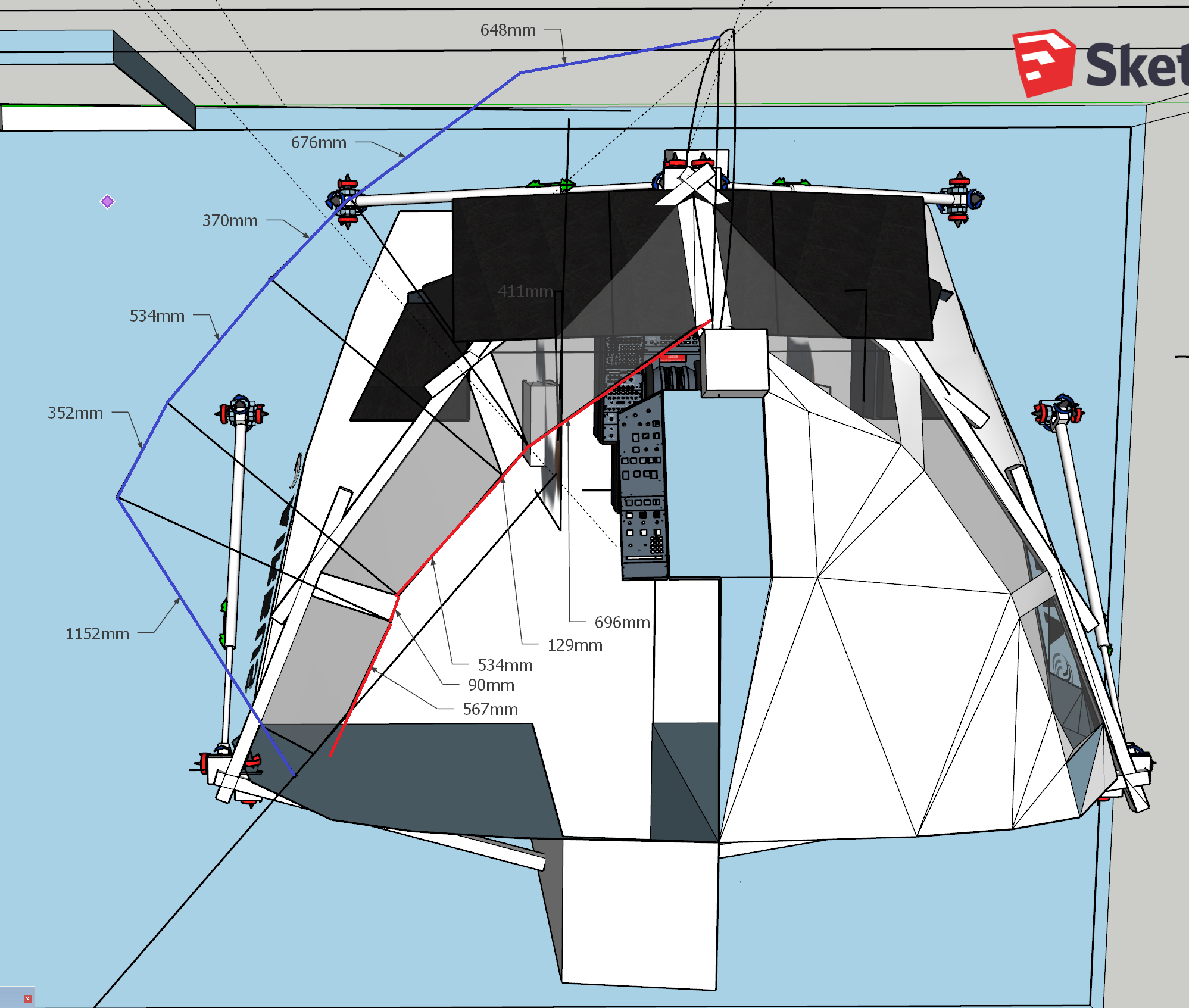
The length of the picture surrounding the cockpit is given at a distance of approx 1m from the upper window line (red line), resulting in a picture length of 7.5m (blue line). The area of the picture is
7.5x0.934m^2 = 7m^2 and a total pixel nr of 7.5m x (2400pixel/934mm) = 19272pixel (projector) or
4.7m^2 and a total pixel nr of 7.5m x (2400pixel/628mm) = 28662 pixel (monitor).
length of surrounding picture

technical issues
Actual TV-standards provide the following pixel arrangements:
7680 × 43208K / UHD-233.2Mp16:9
4096 × 21604K / UHD-18.85Mp19:10 (cinema)
3840 × 21604K / UHD-18.29Mp16:9 (TV)
1920 × 1800Full HD2.07Mp16:9
1280 × 720HD-ready8.29Mp16:9

FullHD-approach:
Most projectors / "pocket-beamers" / "Mini-beamers" provide a 32" picture at a distance of 1m, which gives (3:2 --> (32/sqrt(3^2+2^2))x2x2.54 ) a picture height of 45.1cm. This is half the picture height needed, so 1200pixel need to be displayed per projector, which leads to 'FullHD' and 2 projectors per "coloumn".
FullHD provides 1920 pixel in width, resulting in 10 projectors per "row" (19272 pixel p. picture / 1920pixel p. projector = 10.03 projectors p. picture). In total 20 projectors are needed (~4k6EUR).

The referenced projector provides 6000 lumen per device, giving in sum 120000 lumen. Related to the picture surface of 7m^2 this reflects 120000/7=17142lx to the cockpit and is quite above "10klux=shadow in summer", which seems to me equal to "sitting during summer in Skiatos in the cockpit". Actually, this setup approaches 19klux 'summer, cloudy', which gains the possibility to dimm the brightness, by this derate projector power!
Contrast is given at 6000:1, resulting in a 'dark-picture' of 2.85 lx. Seems also 'ok' compared to the illuminated knobs and panels inside the cockpit, judged to give more light than 3 candles (~2.85lx).

Power dissipation is 20x 100W = 2kW. A 2h flight thus generates vision-costs of 4kWh (=1.20EUR) and makes it necessary to open the windows... In fact, cooling is a topic, not only for the PCs.
The projectors are of the dimensions 26.5x22x8.7cm^3. The flat design is good, the width of 26.5cm results in (10 projectors per side) a length of 2.65m. The sim provides at the upper line of the cockpit windows (red line) a length of 2.02m, which makes it necessary to stack the projectors by 2, increasing the projector device height to 18...20cm!
The projectors weigh 2.3kg each, resulting in a payload of 46 kg in total, without cabling and/or mounting and cooling.

The drawback of weight, height (reduced cockpit 6dof-movement) and assumed difficulties getting 20 projectors merged to 1 picture, the PC-issues along with 20 projectors are quite big: Although using a 6 display-card using only two slots the graphic cards may can get suited in one PC-casing, but as they need 500W each, the PC would need to get powered by approx 2.5kW power supply. A design, quite at its limits.

UHD-approach:
20 Full-HD projectors give a equivalent of 5 UHD projectors. 5 projectors can be supported by 1..2 graphics cards, needing approx 1200W PC power supply, which is a much more suitable PC-design. 5x approx. 1200 EUR = 6kEUR. 5x 2400 ANSI-lumen = 12000lumen / 7m^2 = 1714lx (= 3x an office desk ilumination, but no 'summer day'). 5x 140W = 700W. Summed up, power ratio is better, but price and lx the UHD variant is less attractive compared to FullHD variant. Also UHD needs a "short throw" projector, the edgeds of the projected picture are not that perfect , than by the FullHD-setup.

Both approaches -FullHD and UHD- have their draw backs: FullHD to merge the boundaries of 20 projectors to 1 picture as well as providing 2.5kW of power in a single PC, UHD to cope withe the issues of projected picture edges, beeing a picture from a short throw projector - having its in centre a different projection distance, than at the edges.

Monitor approach:
Focus of the vision system is a compact arrangement. This can also be achieved by monitors. As the angle of sight on the monitor surface should be 90deg, a monitor is not suitable to replace the cockpit window itself, but needs to be mounted outside the cockpit windows. As monitor frames are not matching the cockpit windows, and have still a frame-thickness greater than '0mm', a monitor based solution is always a bit lacking. Although some workarounds have been developed, its always a bit of a 'trade of'.


Role model / simulated aircraft
Well, two things and a heart felt story did come together:
1st, checking out youtube videos of spectacular landings and/or approaches and 2nd checking out the STARs of this approaches.
St Marteen is well known for the closeness spectators can get to the planes. An europeen equivalent airport is Skiatos (LGSK) in Greece.
Checking out the 'STAR's, of these "interesting approaches" I realized, that holiday-locations often have "interesting approaches". Maybe due to most time nice weather conditions, so why spend money on ILS-maintenance?! Flying a 'holiday jet' or 'flying to holday destinations' seems to be a quite cool idea to do: You get the feeling, the intention... but do not have to cope with hot temperatures at the destination, carrying the luggage to the hotel and so on. You have the feeling of holiday by having the comfort to know where the things are due to staying at home (some sort of 'caravaning-effect'). And above all the benefit of interesting approaches paired with bad weather ILS-approaches back here in Germany. So... my cockpit shall be the model of a holiday plane.
By accident, during some Skiathos videos, I fell over the Condor retro-livery of D-AICA. Already a newspaper article some years ago turned my interest to that particular plane. In addition, since ever I sympathised with the brand 'Condor'. I do not know exactly why - maybe out of many flights as a child - Condor got to me as the holiday-variant of the work-live LH: LH when dad flew due to 'business', Condor when we all flew on 'holiday'. The idea got more and more closer, to take the Condor D-AICA as a role model for my sim.
The final straw was the fact, that D-AICA was baptised on the name 'HANS'. The person the name 'Hans' was referred to, was the first contractor of Condor. Actually, I have a different 'Hans' in mind: The person I am referring to, is MY main flight instructor 'Hans'.
So it turned all out to be a good story: Flying to holiday, with interesting and various flight manoeuvers, with a sim devoted to my flight instructor: Thanks for teaching flying, Hans, Good bless you!
Meanwhile the D-AICA had been leased and the plane got the livery of that particular airline. Condor sticked to the "retro-plane", so the livery got shifted to D-AICH, but who cares...
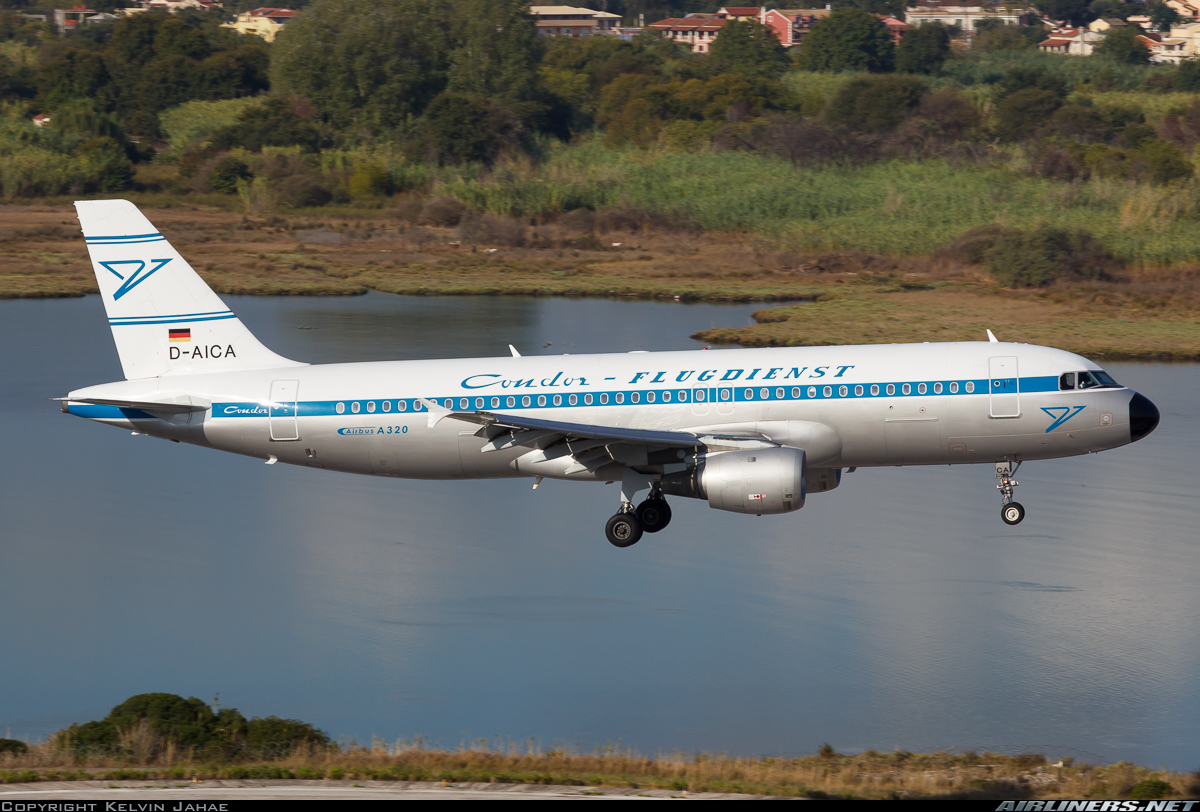
See below the A320 D-AICA MSN 774 how she appeared in her 'old' livery of 'Condor Flugdienst GmbH' on the final to Corfu (LGKR) on 18/SEP/2017:
D-AICA, 'Hans'

https://www.aero.de/news-14033/Condor-Airbus-A320-D-AICA-fliegt-in-Retro-Bemalung.html
https://condor-newsroom.condor.com/de/de/news-artikel/neuer-hans-d-aich-hebt-jetzt-im-retrolook-ab-1/
https://www.airfleets.net/ficheapp/plane-a320-774.htm
https://www.planespotters.net/airframe/airbus-a320-200-d-aica-condor/epwoor
https://xfw-spotter.blogspot.com/1998/02/a320-212-condor-berlin-f-wwdn-d-aica.html
https://www.planespotters.net/production-list/Airbus/A320/A320-200?p=12
https://www.planelogger.com/Aircraft/Registration/D-AICA/906946
https://www.airport-data.com/aircraft/D-AICA.html


[ home ]      [ input ]        concept        [ system design ]      [ mech design ]      [ hw design ]      [ sw design ]      [ integration ]      [ improvements ]      [ tools ]      [ links ]      [ contact ]


change log
12/JUL/2020vision added
08/JUN/2020initial issue